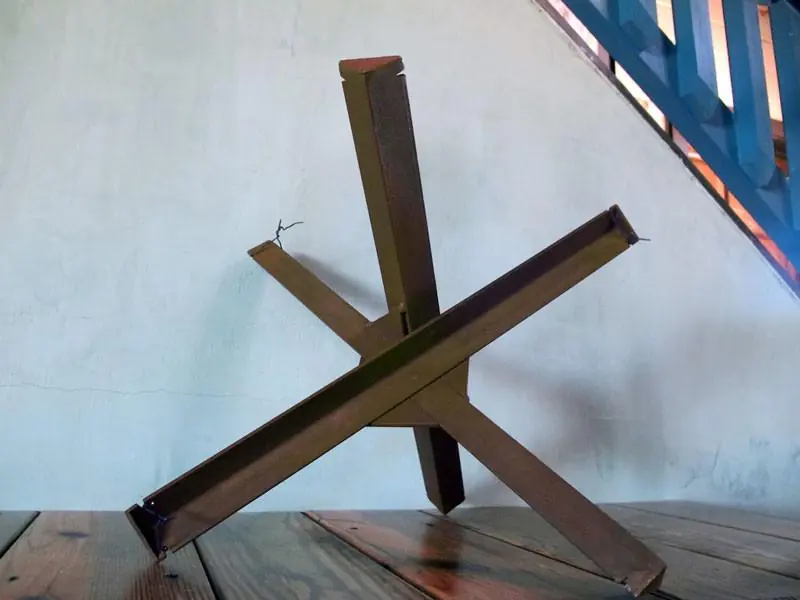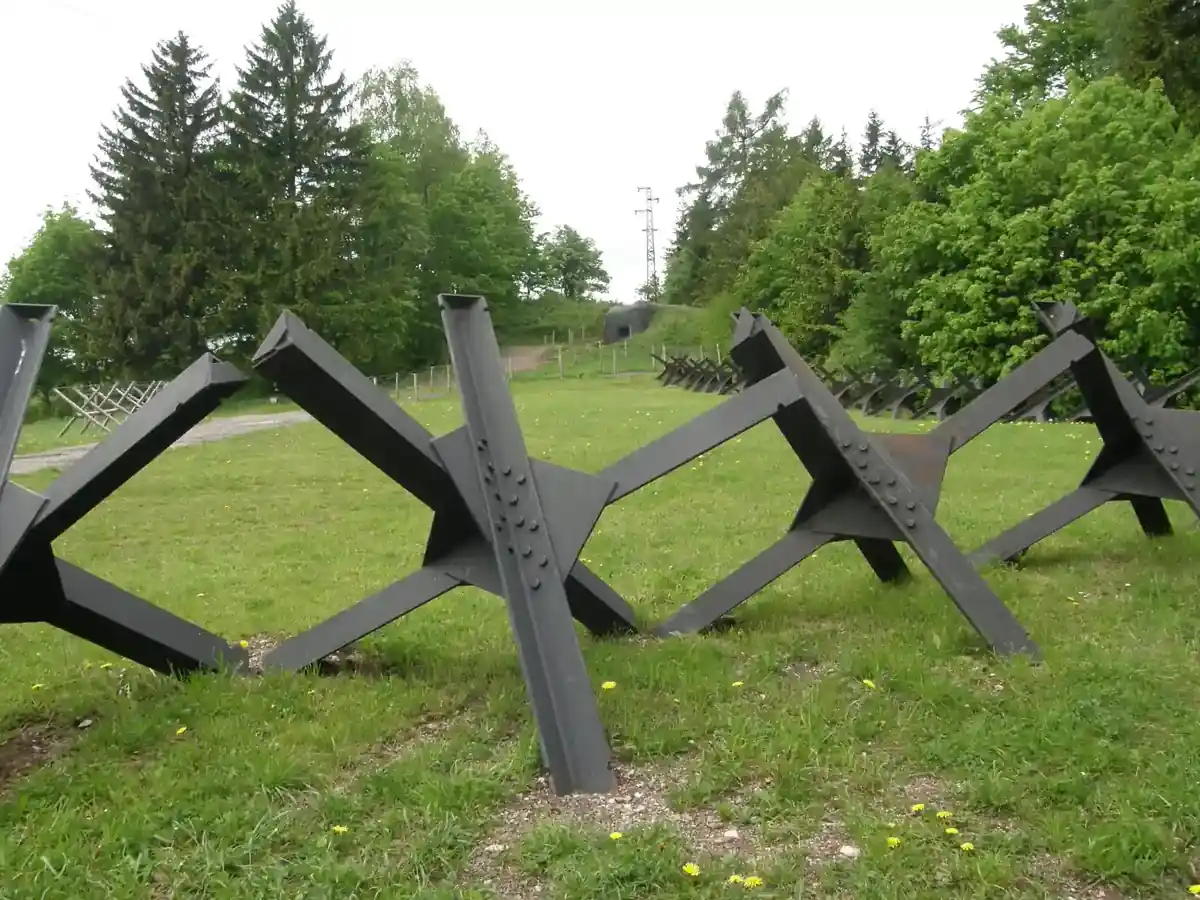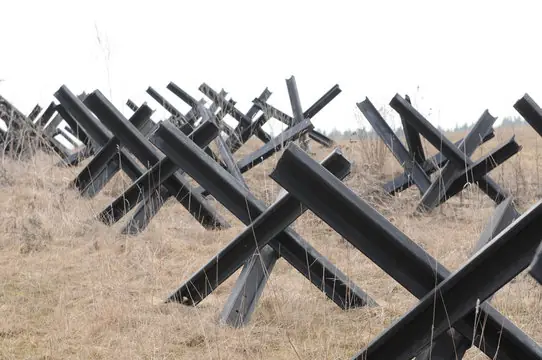
Search "Czech hedgehog manufacturer" online and you will find Halloween prop makers, paintball arena suppliers, and Etsy hobby welders. Not a single result on page one represents an actual military-grade defense manufacturer.
This is a problem for defense procurement officers. When you are sourcing steel barriers for border fortification, military base perimeter security, or critical infrastructure protection, the supplier you select determines whether those barriers will stop a 15-ton armored vehicle or crumble under the first artillery near-miss. A hedgehog welded from 16-gauge sheet metal in a garage workshop is not the same product as one fabricated from EN 10025 L140x140x13 hot-rolled angle steel under ISO 9001 quality management.
This guide gives you the evaluation framework that separates industrial defense manufacturers from hobbyists and entertainment suppliers. Written by the Fortis Barriers engineering team — a manufacturer that has delivered 50,000+ Czech hedgehog units to defense forces across 40+ countries — it covers every criterion you need to verify before issuing a purchase order.
6 Criteria for Evaluating a Czech Hedgehog Manufacturer
The checklist below covers the six dimensions that separate professional defense manufacturers from everyone else. Each criterion directly impacts barrier performance, service life, and your legal compliance as a procurement officer.
| # | Criterion | What to Verify | Red Flag |
|---|---|---|---|
| 1 | Certifications | ISO 9001:2015 QMS, EN 10025 material compliance, ISO 9606-1 welder qualification | "Trust me" — no documentation provided |
| 2 | Material Traceability | Mill test certificates per heat/batch, material grade documented (S235JR vs S355JR), chemical composition reports | "Steel from reliable sources" — no mill certs |
| 3 | Manufacturing Process | CNC cutting, robotic/qualified manual welding, dimensional inspection per unit, surface treatment (HDG/coating) | Hand-cut, hand-welded with no QC documentation |
| 4 | Production Capacity | Factory floor area, dedicated production lines, monthly output capability, buffer stock | "How many do you need? We'll figure it out" |
| 5 | Export & Logistics | Export experience (number of countries), container loading optimization, customs documentation, Incoterms offered | No export track record; "we can try shipping" |
| 6 | After-Sales & Warranty | Warranty terms, replacement policy, technical support availability, spare parts | No warranty or "as-is" sales |
Factory Certifications: ISO 9001, EN 10025 & NATO Standards
Certifications are not marketing badges. They are auditable evidence that a manufacturer operates documented, repeatable quality systems. For defense procurement, certain certifications are mandatory minimums — not optional.
ISO 9001:2015
Quality management system certification — the global baseline for industrial manufacturing. Covers documented processes, continuous improvement, customer satisfaction monitoring, and management review.
Verify: ask for certificate number and issuing body. Cross-check on the certification body's online registry.
EN 10025
European standard for hot-rolled structural steel. Specifies mechanical properties, chemical composition, and testing requirements. S235JR (235 MPa yield) for standard use; S355JR (355 MPa) for heavy-duty.
Verify: request mill test certificates showing heat number, chemical analysis, and mechanical test results.
ISO 9606-1
Welder qualification standard. Certifies that each welder has passed practical tests for specific welding processes, material groups, and positions. Every weld on a military barrier matters.
Verify: request welder qualification records (WPQ) and welding procedure specifications (WPS).
Regional Compliance: EU vs US DoD vs NATO Procurement
Different procurement frameworks impose different supplier qualification requirements. What passes for "certified" in one jurisdiction may not satisfy another. Defense buyers operating across regions need to understand these differences before shortlisting manufacturers.
| Framework | Key Requirements | Implications for Czech Hedgehog Sourcing |
|---|---|---|
| EU Defense Procurement (2009/81/EC) | CE marking, EN 10025 compliance, ISO 9001 minimum. Environmental compliance via REACH regulation for coatings and galvanizing chemicals. | Manufacturer must provide Declaration of Performance (DoP) for steel products. HDG process chemicals must be REACH-registered. |
| US DoD / DFARS | DFARS 252.225-7014 (specialty metals restriction), NIST SP 800-171 cybersecurity if handling CUI. Berry Amendment considerations for textile components. | For steel hedgehogs: specialty metals clause may apply. Chinese-manufactured steel typically requires waiver or non-availability determination. |
| NATO (STANAG 2280) | Performance-based specifications. Interoperability with NATO force structures. Host nation support compatibility. | Hedgehogs must meet defined dimensional and material specs that align with NATO engineering standards for barrier deployment. |
| UN / Peacekeeping Procurement | UN Global Marketplace (UNGM) registration. Competitive bidding with transparency requirements. Developing-country preference provisions. | Manufacturer must be UNGM-registered or willing to register. Competitive pricing documentation required. |
Material Traceability: Steel Mill to Final Assembly
The steel in your Czech hedgehog matters. A barrier fabricated from uncertified scrap steel may look identical to one made from EN 10025-certified material — until it takes an impact at -20°C and the welds fracture because the carbon content was inconsistent.
Material traceability means every piece of steel can be tracked back to its originating mill. The chain looks like this:
-
Steel Mill
Produces hot-rolled angle steel to EN 10025 specification. Issues Mill Test Certificate (MTC) documenting heat number, chemical composition (C, Mn, Si, P, S content), and mechanical properties (yield strength, tensile strength, elongation).
-
Incoming Inspection
Manufacturer verifies material against MTC upon receipt. Checks dimensional accuracy (L140x140x13 mm tolerance), surface condition, and matches heat numbers to certificates. Non-conforming material rejected before production.
-
Production Batch
Each production batch is assigned a unique identifier linking finished hedgehogs to their specific steel heat. If a quality issue is discovered post-deployment, every affected unit can be traced and recalled.
-
Final Documentation
Every shipment includes a documentation package: MTCs for all steel used, dimensional inspection reports, weld inspection records, and coating thickness measurements (for galvanized units).
Manufacturing Process: CNC Cutting, Welding & Galvanizing
Walk through a professional Czech hedgehog manufacturing line and you should see three distinct production stages — not one person with an angle grinder and a stick welder.
CNC Cutting & Preparation
Steel angle beams L140x140x13 mm are cut to precise 2,100 mm lengths on CNC saws. Gusset plates (8-10 mm) are CNC plasma-cut with bolt holes positioned to sub-millimeter tolerance. Manual cutting introduces length variation that affects assembly fit and structural performance.
Welding & Assembly
Two arms are factory-welded by ISO 9606-1 qualified welders using documented WPS. The third arm is bolted on-site with M20 bolts through gusset plates — reducing shipping volume ~30% while maintaining full structural integrity. Every welded joint receives visual and dimensional inspection.
Surface Treatment
Hot-dip galvanizing to 85 μm minimum thickness (ISO 1461) for 30+ year outdoor service life. Alternative: red oxide primer for short-term/temporary deployment, marine-grade coating for coastal/saltwater environments. Coating thickness measured and documented per batch.
The Factory Audit: What to Look for On-Site
A factory visit reveals what documentation cannot. Paper can be forged. A production floor cannot. Here is what to inspect when you walk through a potential Czech hedgehog manufacturer's facility — and what each observation tells you about their actual capability.
| What to Check | Good Sign | Red Flag |
|---|---|---|
| Raw Material Storage | Labeled steel inventory with heat numbers visible, organized by grade, stored under cover or indoors | Mixed scrap pile, no labels, rusted material stored outdoors in rain |
| Cutting Stations | CNC saws with digital readouts, jigs for consistent length, operator following documented setup sheets | Handheld torch or abrasive saw, no measurement jigs, "eyeballing" lengths |
| Welding Area | Welding procedure specifications (WPS) posted at each station, calibrated machines, welder ID tags on completed work | No WPS visible, inconsistent bead appearance between units, no welder traceability |
| Inspection Station | Dedicated inspection area with calibrated measurement tools, inspection checklists per unit, rejection area with root cause tags | No visible inspection process, units flow directly from welding to shipping |
| Galvanizing Line | In-house or contracted HDG facility with coating thickness gauge, documented bath chemistry control | Spray-painted finish called "galvanized," no thickness measurement capability |
| Finished Goods | Organized buffer stock with batch labels, protected from elements, traceable to production records | Random pile in yard, no batch identification, exposed to weather |
Cost Breakdown: Factory-Direct vs Middleman vs E-Commerce
Not all Czech hedgehog prices are comparable. A $400 FOB factory price and a $2,500 online retail price can represent the same underlying product — or completely different ones. Understanding the supply chain markup structure helps you budget accurately and avoid overpaying for a middleman's margin.
| Supply Chain Level | Typical Price (per unit) | What You Get | Best For |
|---|---|---|---|
| Factory-Direct (FOB) | $400-700 | EN 10025 steel, ISO-certified production, full MTC documentation, bulk order pricing, direct communication with engineering team | Defense ministries, government procurement, orders of 20+ units |
| Trading Company / Middleman | $700-1,200 | Same factory product with 50-100% markup, may bundle logistics and local customs clearance. Variable documentation quality — middleman may not have engineering access | Small buyers who value logistics convenience over unit cost |
| Domestic E-Commerce / Reseller | $1,500-2,500 | Product already imported and warehoused domestically. Usually non-structural (entertainment grade) unless explicitly stated otherwise. No MTCs, no factory traceability | Paintball fields, movie props, Halloween displays — NOT defense use |
Procurement math: On a 500-unit order, the difference between factory-direct ($400/unit) and middleman ($1,000/unit) is $300,000 — enough to fund the shipping, customs clearance, and on-site deployment for the entire order with money left over. The documentation quality gap is equally stark: a factory provides MTCs and ISO certificates directly; a middleman may or may not have them. See current factory-direct pricing and availability.
3 Procurement Pitfalls: Lessons from Real Defense Buyers
Over 20 years of manufacturing for defense clients, patterns emerge. Here are three procurement failures we have seen — and how to avoid them.
The Certification Mirage
A procurement team selected a supplier who claimed ISO 9001 certification. The certificate image looked legitimate. After delivery, an audit revealed the certificate was expired and the issuing body had no record of the manufacturer. The hedgehogs were fabricated from unverified steel. The entire order was rejected — after deployment was already delayed by three months.
Prevention: Always cross-check certification numbers against the issuing body's public registry before issuing a purchase order. A five-minute online verification prevents a multi-month procurement disaster.
The "We Can Do That" Trap
A buyer requested S355JR steel grade for a deployment in Northern Europe. The supplier — a general metal fabrication shop — agreed without hesitation. Upon delivery, MTCs were absent. Independent testing revealed the steel was S235JR. The supplier had simply used whatever steel they had in stock, assuming "steel is steel." The barriers were inadequate for sub-zero conditions.
Prevention: Specify MTCs per EN 10204 Type 3.1 as a contractual delivery requirement. Include right-to-reject clause for non-conforming material. Third-party inspection before shipment confirms compliance.
The Shipping Surprise
A defense agency ordered 200 hedgehogs at an attractive FOB price. The manufacturer produced them on schedule — then the buyer discovered that shipping 200 units of 240 kg steel each to their destination cost more than the products themselves. The manufacturer had no export logistics experience and could not advise on container optimization. The budget overrun derailed the project.
Prevention: Request a complete landed-cost quotation (CIF or DAP) before committing. A manufacturer with export experience can optimize container loading — Fortis Barriers' three-arm bolted design reduces shipping volume ~30% vs fully welded units. See dimension and shipping specifications.
Questions to Ask Before Placing an Order
When you send an RFQ to a Czech hedgehog manufacturer, the response quality tells you as much as the price. A professional manufacturer answers these questions in the initial quotation. Hobbyists and resellers avoid them.
-
Can you provide mill test certificates for the steel used in our order?
Expected answer: "Yes. MTCs per EN 10204 Type 3.1 will be included with shipment documentation." If they say "we buy from a reputable supplier" without offering certificates — that is a no.
-
What is your monthly production capacity for Czech hedgehogs?
Expected answer: A specific number with factory floor area, number of production lines, and current order book context. "We can handle any quantity" without specifics means they have not actually produced at scale.
-
Which countries have you exported to, and can you provide export documentation samples?
A manufacturer serving defense clients should have experience with customs documentation, certificates of origin, and potentially ITAR/EAR compliance frameworks.
-
What is your weld quality assurance process?
Expected answer: ISO 9606-1 qualified welders, documented WPS, visual inspection on every unit, and NDT (non-destructive testing) sampling protocol.
-
What warranty do you offer on manufactured Czech hedgehogs?
A manufacturer confident in their quality offers at minimum a material and workmanship warranty. "As-is" or "no warranty" is unacceptable for defense procurement.
-
Can we arrange a factory audit or third-party inspection before shipment?
A transparent manufacturer welcomes this. Resistance to third-party inspection is a red flag for quality control issues.
Commercial vs. Entertainment: What's the Real Difference?
If you search "Czech hedgehog for sale" online, you will find products ranging from $40 Etsy props to $440 paintball arena kits — alongside industrial manufacturers. The differences are not cosmetic. They are structural.
| Factor | Military-Grade Manufacturer | Entertainment/Hobby Supplier |
|---|---|---|
| Material | EN 10025 certified hot-rolled angle steel L140x140x13 mm | 16-gauge sheet metal (~1.5 mm), uncertified mild steel, or thin-wall tubing |
| Unit Weight | 240 kg (standard) — actual vehicle-stopping mass | 10-50 kg — cannot stop even a passenger car |
| Welding | ISO 9606-1 qualified, documented WPS, dimensional inspection | Hobby-level MIG/TIG, no documentation, cosmetic only |
| Certifications | ISO 9001, EN 10025 MTCs, ISO 1461 galvanizing | None — "rustic finish" is marketing, not engineering |
| Intended Use | Military defense, border fortification, critical infrastructure | Halloween displays, paintball obstacles, movie props |
| Price (typical) | $400-700/unit FOB (factory-direct, bulk order) | $40-440/unit retail (non-structural) |
| Documentation | MTCs, inspection records, CoO, packing list | Receipt from Shopify/Etsy |
The bottom line: If your procurement specification says "anti-tank obstacle," you need a manufacturer who understands what a tank weighs and what steel does at -20°C. Halloween props and paintball barriers are legitimate products for their markets — they are just not military products. See our complete Czech hedgehog guide for full technical specifications.
Frequently Asked Questions
At minimum, a military-grade manufacturer should hold ISO 9001:2015 (quality management), provide EN 10025 material compliance with mill test certificates, and employ ISO 9606-1 qualified welders. For NATO-related procurement, additional compliance frameworks may apply. Fortis Barriers maintains all three certifications as standard — provided with every quotation.
Three verification methods: (1) Request documentation — MTCs, ISO certificates, welder qualification records. Cross-check certificate numbers with issuing bodies. (2) Third-party inspection — hire an independent inspection agency like SGS, Bureau Veritas, or TUV to audit the factory and inspect your order before shipment. (3) Reference checks — ask for contact information of previous defense clients (with permission). A manufacturer who cannot provide any of these three is unverifiable.
S235JR (minimum yield strength 235 MPa) is adequate for temperate climates and standard deployment. S355JR (355 MPa) provides 50% higher yield strength — critical for operations in extreme cold where steel becomes brittle, coastal environments with accelerated corrosion, or scenarios where barriers may face repeated vehicle impact. The price difference is approximately 20-30% per unit. For defense procurement in Northern Europe, Canada, or coastal regions, specify S355JR.
Standard MOQ is typically 20 units. Volume discounts apply at 100, 500, and 1,000+ unit tiers. Below 20 units, per-unit costs increase due to production setup overhead. For urgent small-quantity needs, check if the manufacturer maintains buffer stock of standard-configuration units for rapid fulfillment. View Czech hedgehog pricing and availability.
Standard configuration (S235JR, red oxide primer): 2-4 weeks from order confirmation. Custom specifications (S355JR, HDG, non-standard dimensions): 4-6 weeks. Shipping time depends on destination and method: FOB (buyer arranges freight), CIF (seller arranges to destination port). Fortis Barriers provides firm lead time commitments with every quotation — not estimates.
Yes. Fortis Barriers welcomes factory visits and third-party audits at our 50,000 sqm facility in Zhengzhou, China. Remote video tours and third-party inspection agency audits (SGS, Bureau Veritas, TUV) are also supported if travel is not feasible. A manufacturer who refuses factory access should be eliminated from consideration.
Five verification steps: (1) Check for ISO 9001 certification on the issuing body's public registry. (2) Request sample MTCs and verify the steel mill exists. (3) Ask for export references with contactable clients. (4) Request a video tour of the production floor showing current work in progress. (5) Engage a third-party inspection agency to verify the factory exists and operates as claimed. If any step fails, the supplier is unverified. Contact Fortis Barriers for verified manufacturer documentation.
Ready to Source Military-Grade Czech Hedgehogs?
Send your RFQ with quantity, steel grade preference, and delivery timeline. Receive a complete quotation package within 24 hours — including ISO 9001 certificate, sample MTCs, lead time commitment, and FOB/CIF pricing.
All quotations include: mill test certificates, dimensional inspection reports, welding qualification records, certificate of origin, and commercial invoice. Government procurement frameworks supported.
Request Manufacturer Quotation →Last updated: July 2026. Certification requirements may vary by jurisdiction and procurement framework. Verify specific compliance requirements with your contracting authority. About Fortis Barriers manufacturing capabilities.