240 kilograms of hot-rolled angle steel. Three beams crossed at right angles. Zero moving parts. One purpose: stop armored vehicles cold.
The Czech hedgehog is the most enduring anti-tank obstacle in military history — a deceptively simple steel structure that has defended borders from Czechoslovakia's 1930s fortifications to Ukraine's 2022 frontlines. Yet despite its century-long combat record, procurement teams struggle to find clear, manufacturer-verified specifications. Wikipedia tells you the history. News articles mention Ukraine. But nobody tells you what steel grade to specify, how factory pricing works, or why EN 10025 S355JR outperforms S235JR in frozen ground.
This guide closes that gap. Written by the Fortis Barriers engineering team — a manufacturer with 50,000+ Czech hedgehog units deployed across 40+ countries — it covers everything from technical specifications to bulk procurement. Whether you are a defense procurement officer evaluating barrier options or a technical evaluator verifying material standards, here is what you need to know.
What Is a Czech Hedgehog?
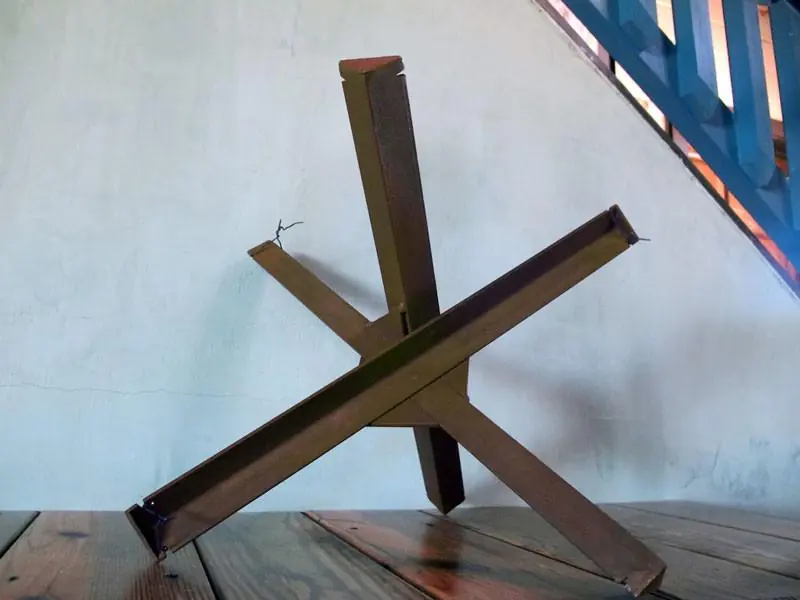
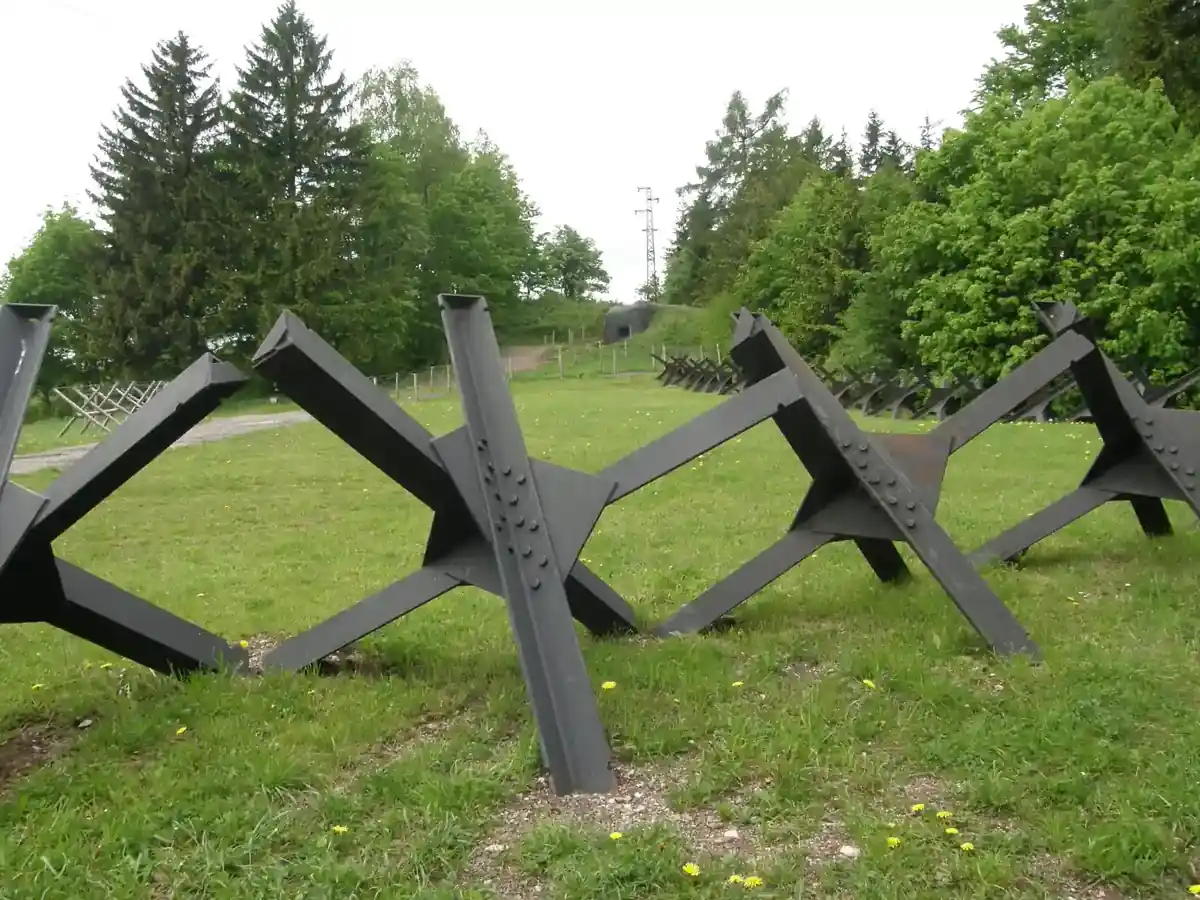
A Czech hedgehog (Czech: rozsocháč or ježek) is a static anti-tank obstacle constructed from three lengths of steel angle beam or I-beam, joined at their centers to form a three-dimensional cross. Each arm extends at right angles to the other two, creating a structure that cannot be simply pushed aside or driven over. The geometry is the engineering genius: regardless of which face contacts the ground, at least one arm always points upward — and that arm is tall enough to lift a tank's treads off the ground or pierce its underbelly.
The design is credited to Czechoslovak Major František Kašík, who developed it in 1935 for the country's border fortification program. The name reflects both its national origin and its resemblance to a curled hedgehog — spines pointing in every direction, no safe approach from any angle.
History and Evolution: From WWII to Ukraine 2022
The Czech hedgehog's operational history spans nearly 90 years and four major conflicts. Below is the timeline of how a 1930s Czechoslovak border defense invention became a 21st-century combat multiplier.
Origins: Czechoslovakia's Border Fortress
Major František Kašík designs the hedgehog for defensive lines along Germany's border. Early concrete prototypes fail under machine-gun fire. Steel replaces concrete by 1937. Approximately 200,000 units manufactured before the Munich Agreement renders the fortifications strategically irrelevant.
World War II: Atlantic Wall & Eastern Front
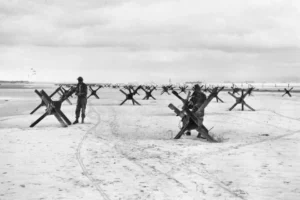
Germany captures Czech stockpiles and deploys them along the Atlantic Wall from Norway to Spain. At Normandy, hedgehogs embedded in tidal zones tear open landing craft hulls. Allies weld captured hedgehogs to Sherman tanks, creating "Rhino tanks" for hedgerow breaching. On the Eastern Front, Soviet forces mass-produce hedgehogs from railway tracks — a single unit blocks entire streets in Stalingrad.
Cold War: Iron Curtain's Steel Spines
Postwar Czechoslovak army tests reveal hedgehogs achieve only 60% effectiveness against heavy MBTs like the T-54 and ISU-152. However, they remain lethal against wheeled vehicles and light armor. Hedgehogs form part of the Berlin Wall's defensive layers and Czechoslovakia's borders with West Germany and Austria. Role shifts from primary anti-tank barrier to rapid-deployment roadblock and urban denial weapon.
Ukraine: A 90-Year-Old Design Returns
Within days of Russia's full-scale invasion, Ukrainian civilians and military units begin manufacturing hedgehogs. Ukrainian Railways repurposes track steel at 33 workshops, producing an estimated 1,800 units. WWII-era hedgehogs retrieved from Kyiv museum storage are deployed at strategic roadblocks. Lviv metalworking shops run continuous production shifts. The images go viral — and procurement agencies worldwide take notice.
How Does a Czech Hedgehog Stop Tanks?
The operating principle is straightforward, but the physics deserve attention if you are specifying barrier configurations for a real defensive line.
-
Vehicle Contact
As a tank or armored vehicle attempts to drive over a hedgehog, its hull or lower glacis contacts the upward-pointing steel beam. The angle — 140 mm wide L-profile — concentrates the vehicle's weight onto a narrow contact surface. Even modern MBTs with 450-500 mm ground clearance cannot ignore the obstruction.
-
Weight Transfer and Tread Lift
The vehicle continues forward, rolling up onto the beam. This lifts the treads or wheels off the ground surface. Once track contact with the ground is broken — even partially — traction drops to near zero. The vehicle cannot steer, cannot accelerate, and cannot reverse without risking further entanglement.
-
Immobilization or Hull Damage
If the vehicle's momentum carries it further, the hedgehog may roll underneath the hull. The steel arms can penetrate thinner belly armor (typically 15-30 mm on many MBTs and far less on APCs and light vehicles). Even without penetration, a 240 kg steel obstacle wedged under the hull renders the vehicle immobile and vulnerable to follow-on fire.
Technical Specifications and Dimensions
Not all Czech hedgehogs are built equal. The table below shows standard manufacturing specifications used by Fortis Barriers, based on original Czechoslovak engineering drawings and updated for modern steel grades under EN 10025.
| Parameter | Standard (EN 10025 S235JR) | Heavy-Duty (EN 10025 S355JR) |
|---|---|---|
| Material | Hot-rolled equal angle steel L140×140×13 mm | Hot-rolled equal angle steel L140×140×13 mm |
| Steel Grade | S235JR — yield strength 235 MPa | Recommended S355JR — yield strength 355 MPa |
| Arm Length | 2,100 mm (standard) | 2,100 mm / 1,800 mm (short variant) |
| Unit Weight | 240 kg | 240 kg / 198 kg (short variant) |
| Effective Height | ≤1,400 mm | ≤1,400 mm |
| Weld Standard | ISO 9606-1 qualified | ISO 9606-1 qualified |
| Gusset Plates | 8 mm steel plate, M20 bolts | 10 mm steel plate, M20 bolts |
| Surface Protection | Red oxide primer | Hot-dip galvanized 85 μm or marine-grade coating |
Why steel grade matters: S235JR is adequate for temperate climates and standard military use. S355JR — with 50% higher yield strength — is recommended for deployments in extreme cold (where steel becomes brittle), in coastal environments (where corrosion accelerates), or where the barrier may face repeated impact. The 2022 Ukraine experience showed that hedgehogs fabricated from railway track steel (roughly equivalent to S355) survived artillery near-misses that would have deformed lighter-grade units. Full dimension specifications and weight tables are available here.
Czech Hedgehog vs Other Anti-Tank Barriers
Defense planners rarely deploy a single barrier type. Each option has trade-offs across mobility, effectiveness, and lifecycle cost. The comparison below evaluates four common anti-vehicle barriers against the criteria that drive real procurement decisions.
| Criterion | Czech Hedgehog | Dragon's Teeth | Jersey Barrier |
|---|---|---|---|
| Deployability |
2-person lift
|
Crane required
|
Crane + flatbed
|
| Anti-Tank Effectiveness |
Light/medium armor
|
All vehicle classes
|
Height-limited
|
| Reusability After Impact |
Geometry self-corrects
|
Destroyed on impact
|
May crack; heavy to move
|
| Manufacturing Speed |
2–4 weeks factory
|
4–8 weeks cure time
|
4–8 weeks cure time
|
| Transport Cost (per unit) |
Stackable, 240 kg
|
1,000–2,500 kg each
|
2,400–4,500 kg each
|
| Service Life |
30+ years galvanized
|
20–30 years
|
15–25 years
|
Bottom line: For rapid deployment scenarios, urban defense, and temporary perimeter hardening, the Czech hedgehog offers the best combination of mobility, effectiveness, and manufacturing speed. For permanent border fortifications, a layered approach combining hedgehogs with dragon's teeth and earthen berms provides defense-in-depth. See our complete anti-tank obstacle comparison for detailed analysis.
Modern Manufacturing and Steel Grade Standards
There is a significant quality gap between improvised hedgehogs — welded from railway scrap in a civilian workshop — and industrially manufactured units built to EN 10025 specifications. Procurement officers need to understand this gap because it directly affects barrier performance, service life, and legal compliance.
EN 10025 Structural Steel
The European standard for hot-rolled structural steel. Fortis Barriers uses S235JR (yield strength 235 MPa) for standard production and S355JR (355 MPa) for heavy-duty or cold-climate deployments. Every heat of steel is traceable to mill certificates — consistent mechanical properties across every batch.
Why it matters: Non-certified steel may have inconsistent carbon content, affecting weldability and low-temperature toughness. A brittle weld failure at -20°C is a barrier failure.
ISO 9001:2015 QMS
Every hedgehog is produced under ISO 9001:2015 certified quality management. Documented welding procedures (ISO 9606-1 qualified welders), dimensional inspection on every unit, and full material traceability from steel mill to final assembly.
Why it matters: Government and NATO procurement frameworks require ISO 9001 as minimum supplier qualification. Without it, your documentation may not pass audit.
50,000 m² Production Base
CNC cutting, robotic welding, and automated hot-dip galvanizing lines under one roof. Industrial-scale production means consistent quality across large orders — not 500 slightly-different units from a job shop.
Learn more about Fortis Barriers manufacturing capabilities and certifications.
Czech Hedgehog Pricing and Procurement Guide
Factory-direct pricing varies based on four factors. The table below helps you budget accurately and avoid procurement surprises.
| Cost Factor | Impact on Unit Price | Best For |
|---|---|---|
| Steel Grade | S235JR: baseline → S355JR: +20–30% | S355JR for cold climates, coastal, high-impact zones |
| Surface Treatment | Red oxide: baseline → HDG: +25–40% → Marine: +50% | HDG for outdoor 30yr life; Marine for saltwater exposure |
| Order Quantity | 100+: -5% → 500+: -12% → 1,000+: -25% | MOQ: 20 units. Volume tiers unlock progressive discounts |
| Shipping Method | FOB: buyer freight CIF: +$150-400/unit | ~40-60 units per 40ft container; stackable design saves freight |
Browse Czech hedgehog for sale with current factory pricing and MOQ details.
Deployment and Installation
Unlike concrete barriers requiring heavy equipment, a steel hedgehog can be positioned by a two-person team using basic hand tools. This deployability advantage is why hedgehogs remain in active military use while concrete alternatives are relegated to permanent installations.
-
Site Preparation
Clear deployment area of loose debris. No foundation required — the hedgehog sits directly on the ground surface. Factory-fitted square foot plates prevent sinking in soft ground. In frozen ground, no preparation beyond snow clearing. In sand or mud, optional ground plates distribute weight.
-
Positioning
Transport to position via two-person lift or hand truck. Place with any face down — geometry ensures an arm points upward regardless of orientation. Street blocking: perpendicular to traffic flow. Open terrain: stagger rows with 1.5–2.0 m lateral spacing. Vehicle gate: position 3 units in arc formation, 1.5 m apart.
-
On-Site Assembly
Fortis Barriers ships with two arms factory-welded and the third arm bolted on-site (M20 bolts through gusset plates). This reduces shipping volume ~30% while maintaining full structural integrity. Assembly time: 15–20 minutes per unit with standard hand tools.
-
Interconnection (Optional)
Link hedgehogs using barbed wire or 12 mm+ steel cable through factory-provided notches on each arm. This creates a continuous barrier line that prevents infantry from dragging individual units aside. For permanent installations, buried steel cable with concrete anchors provides tamper resistance.
Frequently Asked Questions
Factory-direct pricing for a standard EN 10025 S235JR Czech hedgehog (240 kg, red oxide primer) typically ranges from $400-700 USD per unit FOB China port, depending on order volume. Hot-dip galvanized units add approximately 25-40%. Heavy-duty S355JR steel grade adds approximately 20-30%. Volume discounts begin at 100 units. Contact our team with your quantity and specification for an exact quotation with lead time commitment.
Standard production uses hot-rolled equal angle steel L140×140×13 mm in grade S235JR (EN 10025), with minimum yield strength of 235 MPa. For heavy-duty applications — cold climates, coastal environments, or expected repeated impact — we recommend S355JR (minimum yield strength 355 MPa). Both grades are fully traceable to mill certificates. Railway-track steel (typically equivalent to S355 or higher) was used for improvised hedgehogs in Ukraine but lacks documented mechanical properties for formal procurement.
Standard dimensions: arm length 2,100 mm, effective height ≤1,400 mm, unit weight 240 kg. An early variant with 1,800 mm arms and 198 kg weight is also available. The three arms are joined at right angles using 8-10 mm gusset plates with M20 bolts. Factory-fitted square foot plates on each arm end prevent sinking into soft ground. Full dimension specifications and weight tables here.
Against modern main battle tanks (MBTs) with 450-500 mm ground clearance, a single hedgehog is less effective than against WWII-era vehicles. However, deployed in staggered rows with 1.5-2 meter lateral spacing, hedgehogs remain effective by forcing drivers into predictable paths that expose them to anti-tank weapons. Czech hedgehogs remain highly effective against: APCs, IFVs, technical vehicles, and all wheeled military vehicles — which constitute the majority of vehicles in contemporary asymmetric conflicts.
Hedgehogs ship with two arms factory-welded and the third arm detached for compact stacking. A standard 40-foot container holds approximately 40-60 units. Shipping options: FOB (buyer arranges freight), CIF (seller arranges to destination port), and DAP (delivered to named place). Fortis Barriers has export experience to 40+ countries and provides complete documentation: commercial invoice, packing list, certificate of origin, and mill test certificates.
Yes. Fortis Barriers maintains buffer stock of standard S235JR hedgehogs for rapid fulfillment. Factory lead time for standard configuration: 2-4 weeks. Custom specifications (S355JR steel, special coatings, non-standard dimensions) extend to 4-6 weeks. Urgent orders can be prioritized — contact our team with your timeline.
The name reflects both the obstacle's origin in Czechoslovakia (invented by Major František Kašík in 1935) and its visual resemblance to a hedgehog with spines pointing in all directions. In Czech it is called rozsocháč ("branching fork") or ježek ("hedgehog"). The English term "Czech hedgehog" was adopted by Allied forces during WWII and has remained standard military terminology ever since.
For rapid deployment and vehicle-accessible terrain: Czech hedgehogs are generally more cost-effective when factoring total lifecycle costs (manufacturing + transport + installation + maintenance + relocation). Concrete barriers have lower per-unit manufacturing cost but 10x higher transport and installation costs due to weight (2,400-4,500 kg vs 240 kg). Hedgehogs also offer reusability and repositioning flexibility. For permanent fixed fortifications with on-site concrete capability, dragon's teeth may be more economical at scale.
The caltrop is a much smaller anti-personnel/anti-tire device (5-15 cm across) designed to puncture tires or injure foot soldiers. Czech hedgehogs are anti-vehicle barriers at a fundamentally different scale — 1.4 meters tall and 240 kg. A caltrop stops a truck tire; a Czech hedgehog stops the entire truck. The two share similar geometry (spines in all directions regardless of orientation) but serve completely different tactical purposes at different scales.
A standard Czech hedgehog weighs 240 kg — approximately 10% of a typical Jersey barrier (2,400-4,500 kg) and 10-24% of a dragon's tooth (1,000-2,500 kg). This 10:1 weight advantage translates directly to deployment speed and transport cost savings. A flatbed truck that carries 4 Jersey barriers can carry 40+ hedgehogs. The 240 kg weight is balanced: too heavy for one person to easily move alone, light enough for a two-person team without mechanical equipment.
Fortis Barriers supplies Czech hedgehogs at factory-direct wholesale pricing to defense ministries, government procurement agencies, and authorized defense contractors worldwide. MOQ: 20 units. Volume discounts at 100, 500, and 1,000+ unit tiers. Complete export documentation included: commercial invoice, packing list, certificate of origin, and material test certificates. Contact our procurement team for a formal quotation.
Czech hedgehogs are 1,400 mm tall and weigh 240 kg — designed as mobile, repositionable obstacles. Dragon's teeth are typically 900-1,200 mm tall but weigh 1,000-2,500 kg each as fixed concrete pyramids. Hedgehogs emphasize tactical flexibility; dragon's teeth emphasize permanent denial. A hedgehog can be repositioned by two soldiers in minutes; a dragon's tooth requires heavy engineering equipment. See complete dimension specifications.
Request Your Factory Quote
Specify your Czech hedgehog requirements — quantity, steel grade, surface treatment, and delivery timeline — and receive a formal FOB/CIF quotation with lead time commitment within 24 hours.
All quotations include mill test certificates, ISO 9001 compliance documentation, and technical data sheets. We support government procurement frameworks and accommodate specialized documentation requirements including NATO STANAG compliance verification.
Request Factory Quote →Last updated: July 2026. Technical specifications are subject to continuous improvement. Contact Fortis Barriers engineering team for the latest product data sheets. Explore military-grade Czech hedgehog barriers for defense applications.